In this article
Why is it worth starting with the general case
In introductory exercises, it is common to solve each planetary arrangement as an isolated case: one problem with a fixed ring gear, another with a fixed carrier, another with an input at the sun gear, and so on. This works in simple situations, but often hinders the development of conceptual understanding. The student learns separate procedures and then encounters difficulty when interpreting a less familiar train.
The general formulation is more useful because it forces you to look first at the structure of the set. Before deciding which element is locked or which speed is known, the train is described as a kinematic system. This change of perspective usually makes the problem clearer, especially in classes and in situations with multiple gear meshes.

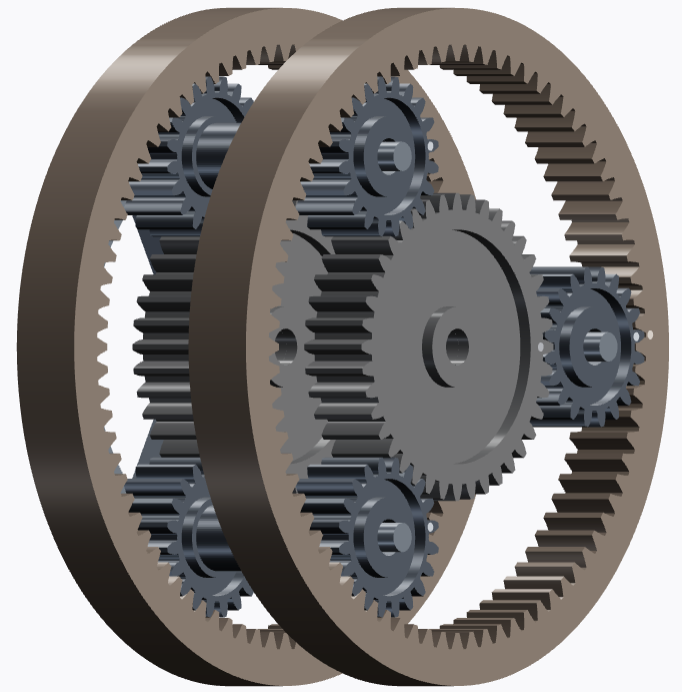
General equation
For any epicyclic gear train, the relation can be written:
The \(e\) parameter represents the train value calculated with the carrier fixed.
- \(\omega_u\): angular velocity of the last gear of the train;
- \(\omega_p\): angular velocity of the train's first gear;
- \(\omega_b\): angular velocity of the carrier.
The decisive point here is that the equation does not describe a special case. It describes the relative behavior of the train relative to the carrier. Once this is understood, the particular conditions come in only as additional constraints.
What does train value mean?
The train value \(e\) is obtained considering the gear chain with carrier fixed. In didactic terms, this is equivalent to momentarily “turning off” the movement of the planet carrier to calculate how the sequence of gears transforms rotation between the first and last element of the train.
This number depends on the topology of the set, the tooth counts and the type of contact between the gears, external or internal. Once obtained, it starts to condense the structure of the problem into a constant that can be used in the general equation.
Simple example: 1-2-3 train
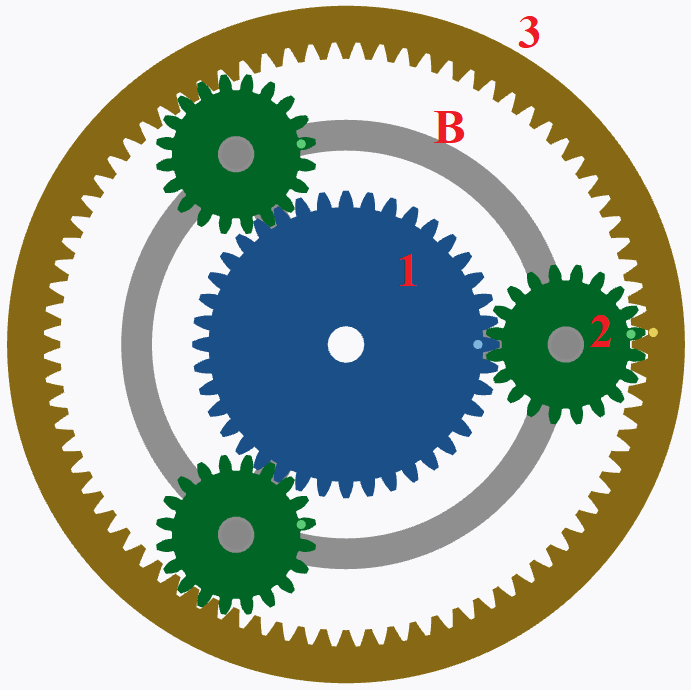
For a train formed by gears 1, 2 and 3, with carrier indicated by \(B\), one can write:
In this expression, \(N_1\), \(N_2\) and \(N_3\) are the tooth counts of the gears involved. The sign of each factor depends on the type of gearing along the chain. The final product provides train value, which can then be used in any coherent operational situation with the same geometric arrangement.
How to interpret the formula without relying on rote procedures
A common mistake is trying to “fit” the equation into decorated tables without thinking about the physical meaning of each term. In planetary gear trains, this often leads to changes between carrier and a fixed element, or confusion between observing the system in real motion and observing the set with the carrier fixed.
A more robust reading is to follow this sequence:
- identify which chain of gears defines the train;
- calculate the value \(e\) with the carrier fixed;
- define input, output and fixed element in the real problem;
- replace known conditions in the general relationship.
This order reduces the number of mental shortcuts and makes it easier to explain reasoning in class or in a technical report.
Where this formulation is most useful
The general form is particularly advantageous when the arrangement is no longer elementary. In composite systems, in chains with several gears or in problems where you want to compare different input and output choices, the formulation helps maintain coherence of reasoning. Instead of rebuilding everything from scratch for each scenario, we work on the same kinematic basis.
Therefore, it also works well with visual tools like Engrenarium. The simulator can help you see the arrangement; the general formulation helps organize the mathematical interpretation of what is being observed.
Read also: projects page, Engrenarium Web and educational applications →
Questions about an equation or result? Send this page address and your calculation inputs to arturavelar@ufsj.edu.br. · About the author · Privacy