In this article
This article shows how to assemble a teaching model of the Ford Model T transmission in Engrenarium and how to interpret its operation. The assembly uses three planetary gear sets and changes the constraints to obtain first gear, second gear and reverse gear.
Engine context
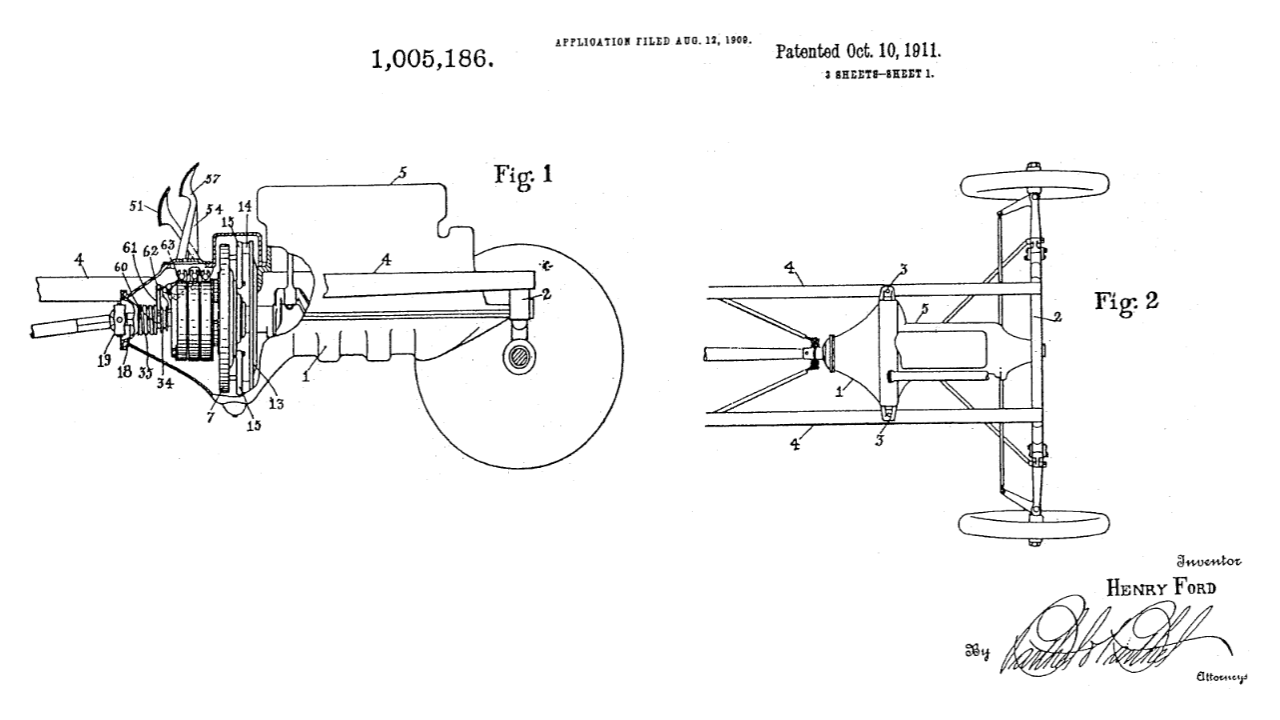
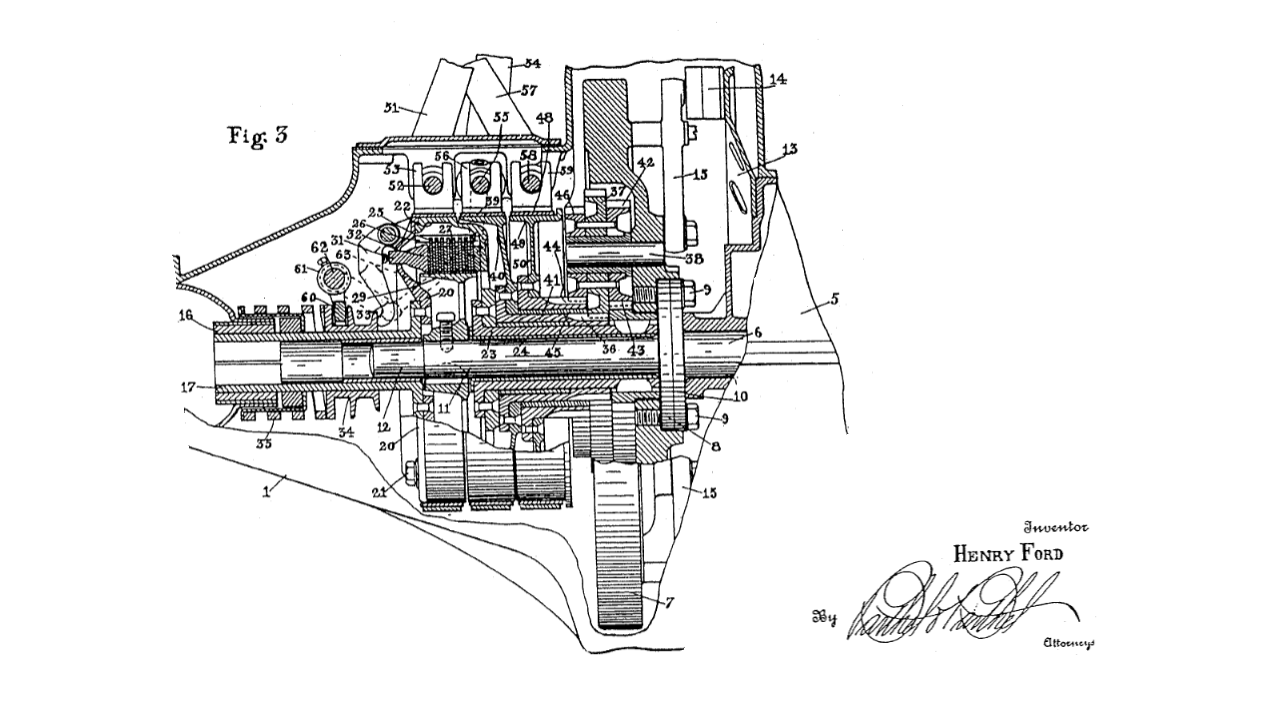
The Ford Model T was produced between 1908 and 1927 and became one of the most influential automobiles in history for combining low cost, robustness and ease of maintenance. One of the interesting points for studying mechanisms is its transmission, which does not follow the visual form of a modern manual gearbox with sliding gears.
For the didactic model, transmission is organized into three operating ratios:
| Condition | Gear ratio |
|---|---|
| First gear | \(2.75\) |
| Second gear | \(1.0\) |
| Reverse gear | \(-4.0\) |
The negative sign of reverse gear represents a reversal of the direction of the output in relation to the input. The second gear with relation \(1.0\) represents a direct condition, in which input and output rotate with the same angular speed.
Engrenarium setup data
The video description informs the tooth counts of the sun gears and the planets of the three planetary systems. These values form the basis of the assembly in Engrenarium:
| Set | Sun gear | Planet | Calculated ring gear |
|---|---|---|---|
| Planetary 1 | \(N_{sun}=27\) | \(N_{planet}=27\) | \(N_{ring}=81\) |
| Planetary 2 | \(N_{sun}=21\) | \(N_{planet}=33\) | \(N_{ring}=87\) |
| Planetary 3 | \(N_{sun}=30\) | \(N_{planet}=24\) | \(N_{ring}=78\) |
The values of the inner ring above are obtained by the geometric condition of a simple planetary with the same module:
Transmission assembly
The Model T transmission can be read as a planetary gear train with elements that take on different functions depending on the gear. Instead of thinking only about external gear pairs, the most useful reading is to ask: which element receives movement, which element delivers movement and which element is locked or coupled to another?
In Engrenarium assembly, the general relationship is written as the ratio of input angular velocity to output angular velocity:
This form makes it clear that the gear is not just a number: it is a consequence of the kinematic condition applied to the elements of the planetary gear train.
Gear configurations
After creating the three planetary gear sets, keep the same geometry and save a constraint configuration for each gear. The input, output and locked or coupled elements define the final relationship.
First gear
In first gear, the condition applied is the locking of the sun 2:
When an element of the train is braked, the internal relative speeds are no longer free and the exit begins to occur with reduction. With the tooth counts and constraints above, the first gear corresponds to the \(2.75\) ratio, that is, the input rotates more times than the output to produce greater traction capacity at low speed.
Second gear
Second gear is a direct condition. To do this, apply equality between carrier 1 and sun 1:
Substituting this equality into the general relation, we obtain \(i=1.0\). This means that the input angular velocity and the output angular velocity are the same. In driving terms, it is forward gear.
Reverse gear
When reversing, another locking condition applies:
The relationship indicated for reverse is \(-4.0\). The module shows a greater reduction than in second gear, while the negative sign indicates that the output rotates in the opposite direction to forward motion. This is the essential kinematic reading: reverse is not just a slower gear, but a condition that reverses the direction of rotation of the output.
Didactic reading
The Ford Model T transmission is a good example to study planetary gear trains because it shows three behaviors in the same set: reduction for low speed, direct gear and reversing direction. The difference between them is not in physically changing the entire set of gears, but in changing the restrictions applied to the elements of the mechanism.
Therefore, the analysis workflow must follow this order:
- identify input and output;
- define which planetary elements are free, locked or coupled;
- write the relationship between angular velocities;
- interpret the ratio sign to distinguish forward and reverse;
- interpret the ratio magnitude as reduction or direct gear.
This type of reading also helps to compare the Model T's transmission with other planetary systems presented on the portal, such as didactic CVT transmissions and compound planetary gear sets modeled in Engrenarium.
Questions about an equation or result? Send this page address and your calculation inputs to arturavelar@ufsj.edu.br. · About the author · Privacy