In this article
This article shows how to assemble a didactic Ravigneaux transmission model in Engrenarium and how to interpret its gear ratios. The reading focuses on the teeth in the assembly, the locking or coupling conditions, and why this arrangement is useful in compact automatic transmissions.
What is a Ravigneaux set
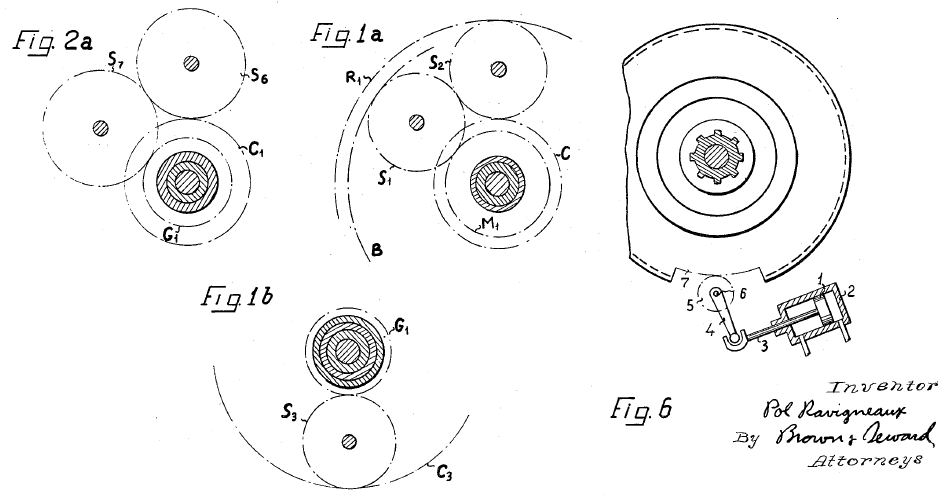
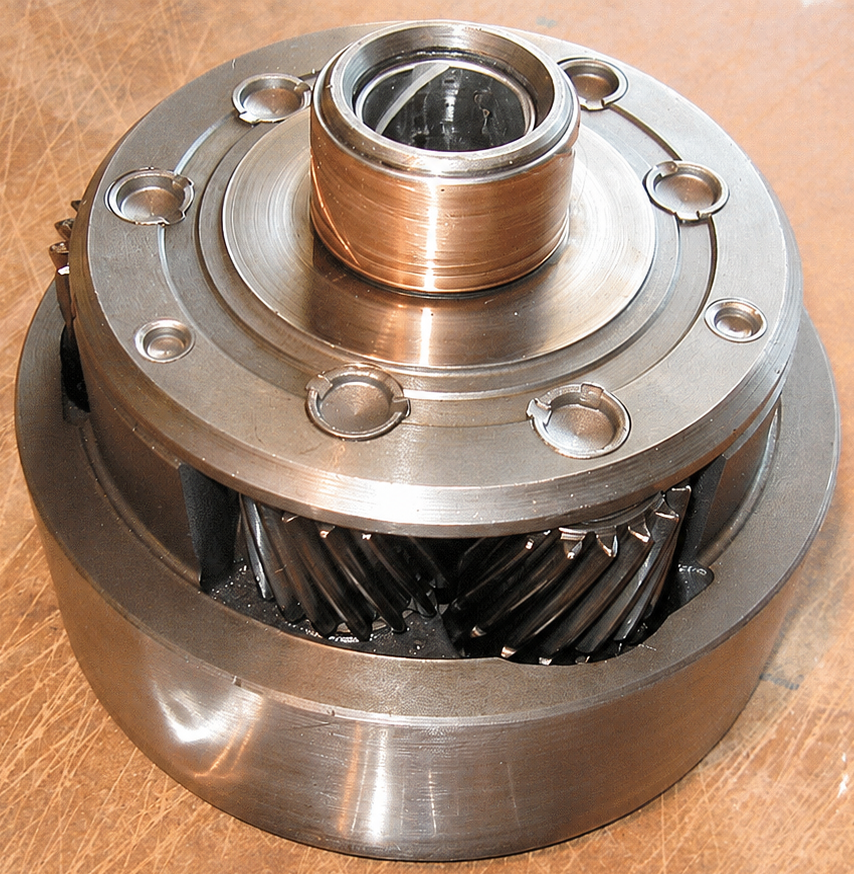
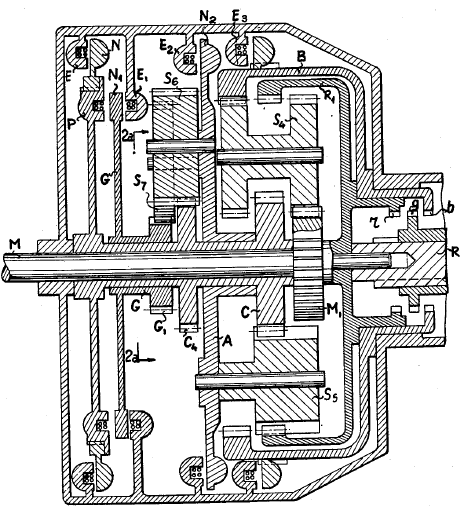
The Ravigneaux planetary gear set was patented in 1949 by Pol Ravigneaux. It brings together two sun gears, long and short planet gears, a ring gear and a single planet carrier, functioning as if two planetary systems were combined into a single structure.
Application in Ford transmissions
Ford overdrive automatic transmissions used a Ravigneaux assembly. The 4R70W model appeared in several vehicles, including:
- Ford Explorer, from 1996 to 2001;
- Ford F-Series, from 1993 to 2003;
- Lincoln Town Car, from 1993 to 2004;
- Mercury Grand Marquis, from 1995 to 2004;
- Ford Expedition, from 1997 to 2004.



Gear ratios
The 4R70W transmission can be represented by five ratios: four forward gears and one reverse gear.
| Condition | Gear ratio |
|---|---|
| 1st gear | \(2.84\) |
| 2nd gear | \(1.55\) |
| 3rd gear | \(1.0\) |
| 4th gear | \(0.7\) |
| Reverse gear | \(-2.32\) |
The above ratios are written as the ratio of input angular velocity to output angular velocity. Ratios greater than \(1\) indicate reduction; the \(1.0\) ratio indicates direct gear; and the \(0.7\) ratio indicates overdrive, in which the output rotates faster than the input. The negative reverse sign indicates a reversal of direction.
Engrenarium setup data
The video description informs the tooth counts used to assemble the model. The important point is that the two subsystems share the same ring gear with \(88\) teeth, a feature that helps to compact the Ravigneaux set.
| Subsystem | Sun gear | Planets | Ring |
|---|---|---|---|
| Planetary 1 | \(N_{sun}=31\) | \(N_{planet\,1}=24\), \(N_{planet\,2}=25\) | \(N_{ring}=88\) |
| Planetary 2 | \(N_{sun}=38\) | \(N_{planet}=25\) | \(N_{ring}=88\) |
In Engrenarium, this data must be used to create the two combined trains. After that, keep the common planet carrier and the output ring, only changing the boundary conditions of each gear.
Gear configurations
With the geometry defined, each gear is obtained by a configuration of constraints. The analysis below uses the same output at the ring gear and alternates input, locks and couplings to reproduce downshift, direct gear, overdrive and reverse.
1st gear
In first gear, configure the input in the first sun gear and the output in the second ring gear:
The boundary condition is the locking of the first planet carrier:
With the planet carrier stopped, the set works as a strong reduction. This is the appropriate condition for starting, when greater torque multiplication and lower output speed are desired.
2nd gear
In second gear, the ratio is still read between the first sun gear and the second ring gear:
The condition that changes is the locking of the second sun gear:
This change reduces the ratio compared to first gear. The output starts to rotate faster for the same input speed, but still with reduction.
3rd gear
The third gear is direct gear. The same kinematic ratio is used, but now with coupling between the two sun gears:
When the relevant elements rotate together, the train stops producing internal reduction and the effective ratio approaches \(1:1\).
4th gear
In fourth gear, the input considered passes through planet carrier and the output remains at the ring gear:
The condition applied again is the locking of the second sun gear:
Since \(i_4 < 1\), this is an overdrive ratio. The output rotates faster than the input, which helps reduce engine speed while cruising.
Reverse gear
In reverse gear, the relationship is written between the second sun gear and the second ring gear:
To invert the output direction, the first planet carrier remains locked:
The negative sign indicates a reversal of direction. Thus, reverse is not just a high reduction ratio; it is a kinematic condition that makes the output rotate in the opposite direction.
How to interpret the set
The Ravigneaux is efficient as an object of study because it concentrates several ratios in a single gear package. In each gear, the transmission selects which elements are locked, which are coupled and which serve as input or output.
The reading script is the same as that used in other planetary gear trains:
- identify the input and output of the gear;
- mark which elements are fixed, such as sun gears or planet carrier;
- check whether there is coupling between elements, such as coupled sun gears;
- calculate the ratio \(\omega_{in}/\omega_{out}\);
- interpret the magnitude as reduction or overdrive and the sign as direction of rotation.
This approach avoids treating each gear as an isolated case. What changes from one gear to another is the set of constraints applied to the same mechanism.
Questions about an equation or result? Send this page address and your calculation inputs to arturavelar@ufsj.edu.br. · About the author · Privacy